Pool shock calculator
The right shock level depends on your stabilizer. Enter it and get the dose for the product on your shelf.
In short: Shock to about 40% of your stabilizer (CYA) level, and never less than 10 ppm. With 50 ppm of CYA, a 15,000-gallon pool at 2 ppm needs 18 ppm more: about 2.2 gallons of 12.5% liquid chlorine.
Formulas reviewed November 1, 2026 · How we calculate
Using your saved pool: . My pool
2.16 gal (276 fl oz)
of liquid chlorine 12.5% raises free chlorine from 2 to 20 ppm. Add it at dusk, pour it in front of a return jet, and keep the pump running.
- Shock level
- 20 ppm
- Increase
- 18 ppm
- Stabilizer
- 50 ppm
What to add
- 2.16 gal (276 fl oz)Liquid chlorine 12.5%
What would change your result
- Shock at dusk and hold chlorine at this level, retesting every few hours, until the water is clear.Read
Keep chlorine at shock level and retest every few hours until the water is clear. Stay out of the pool until free chlorine is back to your normal level.
How much shock for your pool: chart
12.5% liquid chlorine to shock from 2 ppm, by stabilizer level. Shock level is about 40% of CYA, at least 10 ppm.
| Pool size | CYA 30 (shock to 12 ppm) | CYA 50 (20 ppm) | CYA 70 (28 ppm) |
|---|---|---|---|
| 10,000 gal | 102.4 fl oz | 1.44 gal (184 fl oz) | 2.08 gal (266 fl oz) |
| 15,000 gal | 1.2 gal (154 fl oz) | 2.16 gal (276 fl oz) | 3.12 gal (399 fl oz) |
| 20,000 gal | 1.6 gal (205 fl oz) | 2.88 gal (369 fl oz) | 4.16 gal (532 fl oz) |
| 25,000 gal | 2 gal (256 fl oz) | 3.6 gal (461 fl oz) | 5.2 gal (666 fl oz) |
| 30,000 gal | 2.4 gal (307 fl oz) | 4.32 gal (553 fl oz) | 6.24 gal (799 fl oz) |
Getting it right

Your shock level depends on stabilizer. The more cyanuric acid (CYA) in the water, the higher chlorine must go to kill algae. That's why "one bag per 10,000 gallons" often fails.
Shock at dusk. Sunlight destroys chlorine. An evening dose works all night.
Hold the level. For a green or cloudy pool, one dose is rarely enough. Retest every few hours at first and top back up to the shock level until the water is clear and chlorine holds overnight.
Pick the right product. Liquid chlorine adds nothing else. Cal-hypo adds calcium, dichlor adds stabilizer, and tablets are too slow for shocking.
Key facts
- Stabilizer (CYA) slows chlorine down, so a stabilized pool needs a much higher chlorine level to shock.
- A common rule of thumb is to shock at about 40% of the CYA level, and never below 10 ppm.
- One pound of 65% cal-hypo raises 10,000 gallons by about 7.8 ppm, not the “1 lb shocks 10,000 gallons” many bags imply.
How it's calculated
Shock level = 40% of your stabilizer (CYA) reading, with a minimum of 10 ppm, rounded to the nearest 0.5 ppm.
The dose is the chlorine needed to go from your current reading to that level: pool gallons × ppm increase × 8.34 ÷ 1,000,000 pounds of chlorine, divided by the product’s strength. For liquid chlorine, 1 gallon of 10% raises 10,000 gallons by 10 ppm.
Questions people ask
How much shock do I put in my pool?
Enough to reach your shock level, which depends on your stabilizer. With 50 ppm of CYA that is about 20 ppm of free chlorine; the calculator turns it into an amount of product.
How much liquid shock for a 15,000-gallon pool?
With 50 ppm of stabilizer and 2 ppm of chlorine now, about 2.2 gallons of 12.5% liquid chlorine to reach the 20 ppm shock level.
When is the best time to shock a pool?
At dusk or at night. Sunlight burns off unstabilized chlorine quickly, so shocking in the evening makes the dose last.
How long after shocking can I swim?
When free chlorine is back down to your normal range. Test before swimming instead of going by a fixed number of hours.
Is liquid chlorine or powder shock better?
Both work. Liquid chlorine adds nothing else to the water. Cal-hypo adds calcium and dichlor adds stabilizer, which matters if you shock often.
Pool care guides
- How to Shock a Pool: When, How Much and Which Shock to UseShocking means raising chlorine high enough, long enough, to kill what normal levels can't. Here's when to do it, how to find your shock level from your stabilizer, and which product to use.
 Shocked Your Pool? What to Do Next (and Why It's Cloudy)What happens after you shock a pool, how long to wait before swimming, why the water often turns cloudy, and how to tell when the shock has done its job.
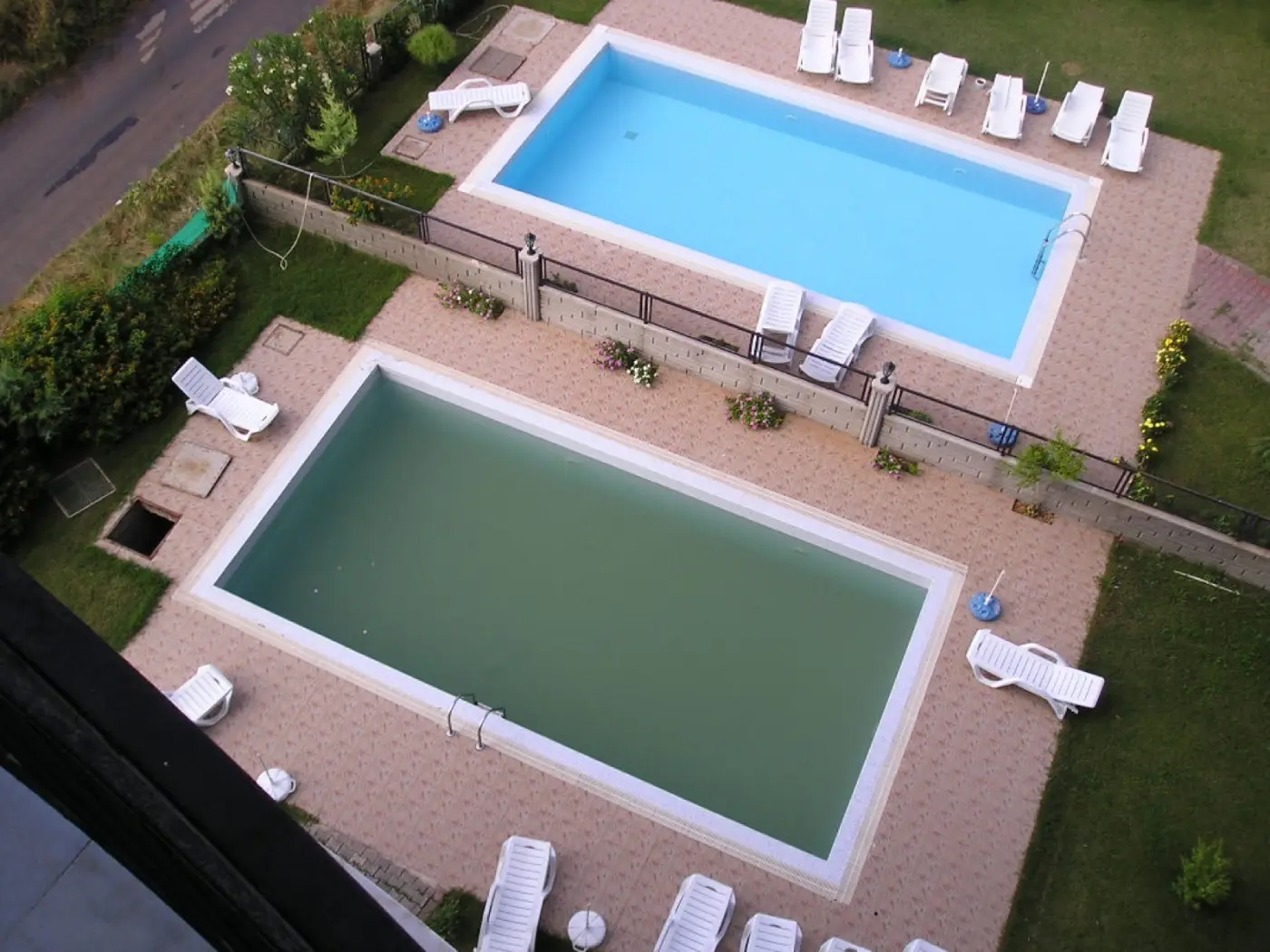 Why Is My Pool Green? Causes and a 4-Step FixA green pool almost always means algae: chlorine fell too low for your stabilizer level. Here's how to find the cause, clear it in days, and keep it from coming back.
Other pool calculators
- Pool volume calculatorHow many gallons your pool holds
- Pool salt calculatorHow many bags of salt to add
- Pool chemical calculatorChlorine, alkalinity, calcium, stabilizer
- Pool pump calculatorFlow rate, run time and cost
- Pool heater calculatorBTU size and heat-up cost
- Pool fill cost calculatorWater cost and time to fill
- Pool chlorine calculatorHow much chlorine to add
- Pool heat pump size calculatorWhat size heat pump you need
- Hot tub chemical calculatorSpa chlorine, alkalinity and calcium
- Hot tub electricity cost calculatorWhat your spa costs to run